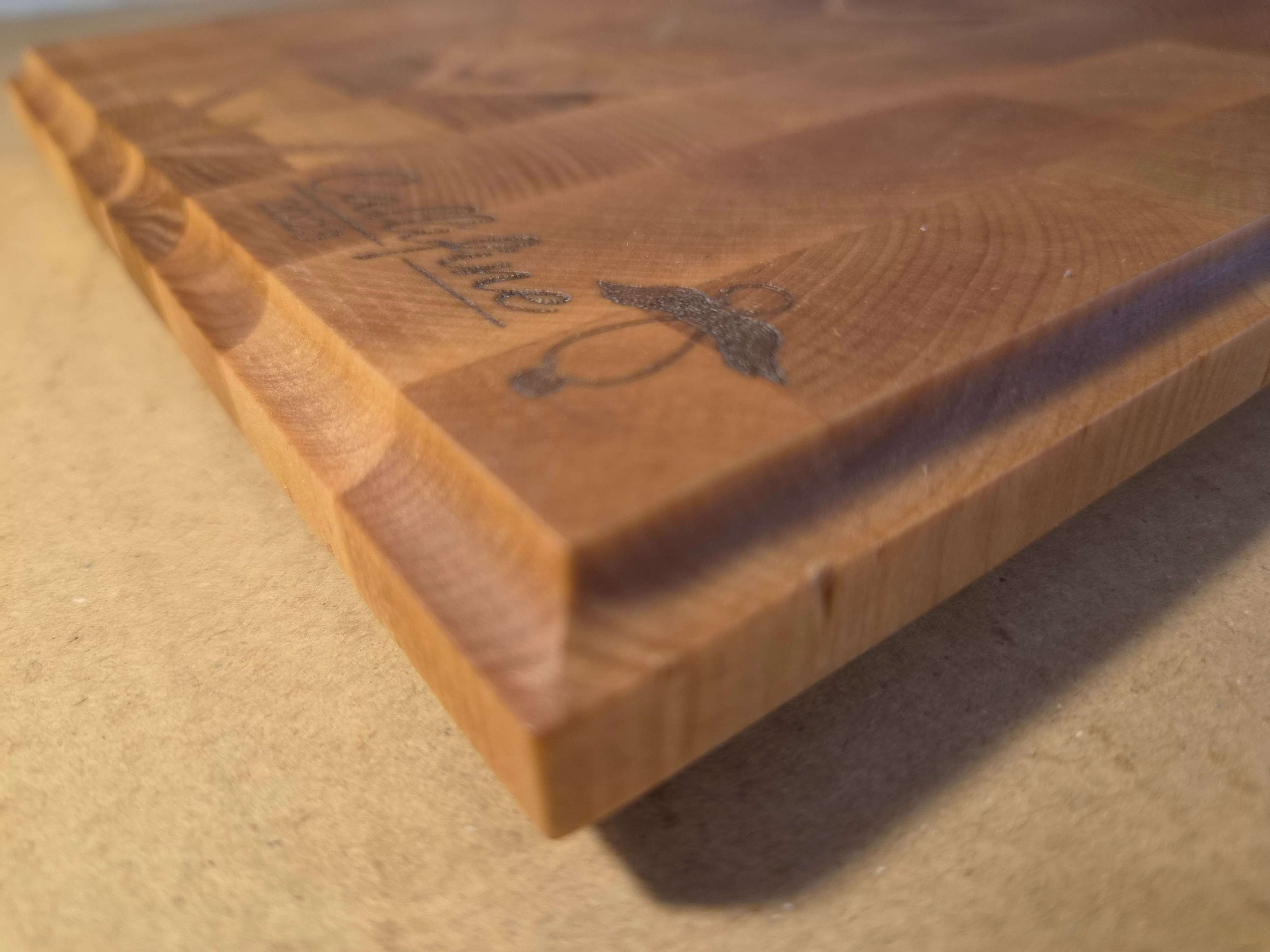
END-GRAIN Cutting Board
End-grain cutting boards are gentle on knives, self-healing, and highly durable. Their construction means the wood fibers are oriented vertically toward the knife edge—rather than lying horizontally—which gives the board unique properties in the kitchen.
Key Benefits
• Gentle on knives: The knife edge slides between the upright wood fibers instead of cutting straight across them. This reduces friction and helps your kitchen knives stay sharp for significantly longer.
• Self-healing surface: When you lift the knife, the wood fibers close back up on their own. This keeps the surface looking fresh for longer and results in fewer deep grooves compared to a standard cutting board.
• Exceptional durability: End grain is the hardest and most wear-resistant part of the wood. A thick end-grain cutting board can withstand heavy use and, after many years, can easily be sanded down to look like new again.
• Hygienic and antibacterial: Wood possesses natural antibacterial properties; it draws moisture and bacteria into its fibers, where the bacteria perish. Because the surface develops fewer deep cuts, there is also less space for food residue to accumulate.
Things to Consider
• Requires more maintenance: Since end grain absorbs more liquid than edge-grain or face-grain wood, the board must be oiled regularly with a food-safe oil (such as paraffin oil) to prevent it from drying out or cracking. You can also apply a finish using beeswax or a dedicated "cutting board wax."
• Not dishwasher safe: Like all wooden boards, it must be washed by hand and left to dry in an upright position to maintain its shape.
IMPORTANT: Even if you have only used one side of the cutting board and/or are washing only one side, make sure to dampen the other side to the same extent. This prevents it from warping (bending).